
Deep Thinking, Pen and Paper
In this article, I talk about how the habit of using a notebook and pen strategically has helped me think deeply about the important themes in my life and sustain planned change.
In this article, I talk about how the habit of using a notebook and pen has helped me think deeply about important topics, and make and execute plans more effectively. I also share the strategies I use to get the most out of a notebook, a device that’s so easy to leave forgotten in a corner these days, but which, used correctly, can be a powerful instrument of change.
TL;DR
If you’re very impatient, or short on time to read the whole thing, you can jump straight to the List of materials section. But I believe the first part has its value, and I invite you to explore the article in full, and maybe even contribute a comment or some feedback.
We all have two lives
How many lives simply “happen”? How many dreams are kept forever as dreams, never realized?
A few days ago, I watched Charlie Kaufman’s new film, “I’m Thinking of Ending Things”, and one particular dialogue got me thinking again about this recurring theme. In the film, the character Lucy, who supposedly studies quantum physics, argues that people tend to think of us as active beings traveling through time, always toward the future, but that they’re wrong; that in reality we’re stationary, and it’s time that passes through us, relentlessly. And I think there’s a good deal of truth in that. We’re very good at letting life happen.

So what does it take for a person to take control of their destiny? What tools do we need to master to at least try to make our dreams come true?
Maybe the first step is wanting to take control. Maybe we have to acknowledge that we only get one life. Everyone knows that, at least superficially, but the Chinese philosopher Confucius describes the situation quite elegantly:
We have two lives, and the second begins when we realize we only have one.
For some people, a disruptive event in their lives can be the trigger for change. In other cases, change is gradual.
You can live a long time on the threshold, flirting with change, aware that you need to change, gathering the strength or trying to build the discipline needed to meaningfully shift your status quo, and enjoy a second life with purpose.
I believe that with persistence and dedication, it’s possible to transform our lives through planned, well-thought-out changes in areas like career, hobbies, habits, and relationships.
I see myself in that second group, and I notice two traits that are essential to drive this kind of change in our lives: discipline and the ability to think deeply about the things that matter.
Discipline is essential because meaningful change is necessarily hard. Making this kind of change consumes an immense amount of energy; it can even be a painful process, and unless we’re prepared to endure it, the chance of seeing the change through drops drastically.
The other important skill for driving these changes is being able to think deeply about the things that matter. This process, also known as deep thinking, is what I’ll cover for the rest of this article.
Deep thinking
Thinking deeply is hard. Try challenging yourself to think about a single topic for a full hour, without breaks. In principle, it’s a simple task: just pick an interesting topic and start thinking. Try it yourself.
Most of us won’t be able to do it. Within minutes or seconds our thoughts will have wandered down strange paths, and in the blink of an eye we’ll be thinking about things that have absolutely nothing to do with the topic we set out to explore moments earlier.
Our minds are naturally prone to these daydreams, and today’s hyper-connected world, with its constant stimuli, makes the task enormously harder. That’s a challenge for any work that demands sustained concentration, and deep thinking is no different.
Stephen Guise, author of the book Mini Habits, wrote a great article years ago called “Deep Thinking Can Change Your Life”, in which, among other things, he argues that to think deeply about a topic, we need to learn to refocus. Every 10 seconds or so, we need to refocus and pick up the train of thought we’d been following. In 10 minutes, we’ll have refocused 60 times!
It’s a skill that takes a lot of practice, but once mastered, it can bear precious fruit and become a transformative element in our lives.
Deep thinking can be used to explore virtually any topic. On career, we can think about what we like or dislike about our current job, what we want to achieve, the pros and cons of landing this or that position, how to become a better professional, the impact of switching careers in two years and everything that entails, or whether it wouldn’t be better to drop everything and open a restaurant. Thinking deeply about a topic can be extremely revealing, but most of us don’t do it as often as it deserves.
That’s one of the reasons so many people put up with a mediocre job for far too long. Instead of thinking deeply about the future they want to build (which takes energy), they let the situation get worse and worse, until the only option left is a radical change. The problem is that when that moment comes, and the person finally gathers the energy to break out of inertia, they’re unprepared to seize the opportunities. They never stopped to think deeply about the future they want. And without a clear vision of where you want to go, any road will do. With few exceptions, the result is that they end up in another mediocre, disappointing job.
The ability to think deeply can go a long way toward changing things. Unfortunately, it’s a very hard skill to master, and it may even be out of reach for some people. There are even more extreme mental conditions, such as overthinking and thought addiction, that make following a single line of thought very difficult.
Finally, there are environmental factors. Deep thinking usually requires a distraction-free environment, and not everyone has one available at all times.
A few years ago, I learned there was an alternative that worked much better for me.
Pen and paper
The value of pen and paper as a tool for learning and for aiding deep thinking was, for me, something I discovered little by little.
My journey with paper
For years, I used pen and paper only for short daily to-do lists. They might be for work or personal stuff, but that was it. And that was a very poor use of paper. For taking notes, I used Evernote.
I still use Evernote, but for a very specific purpose: it’s a repository for storing unexplored ideas.
Picture this: you’re walking to work or washing the dishes while listening to an interesting podcast episode, or you see something unusual, and a spark of creativity hits: you have an idea. Maybe it’s an idea for an app, a product, a business opportunity, a story, or a topic for your blog. Whatever it is, you have a few seconds to capture it, or it might slip away. You can fool yourself into thinking you’ll remember it later because it’s brilliant, but only someone who has forgotten an idea knows how much it hurts to lose one.
Exploring those ideas can happen later, with the calm and attention they need.
Influenced by my friend Alexandre Mendonça Álvaro, I picked up the habit of planning my workdays using a technique he calls Mind Defrag. That was around 2016. Over the years, I ended up developing other ways of planning my activities that worked better for me.
Less than a year earlier, I had started studying creative writing and writing fiction in my spare time, and I had already found that pen and paper were a great tool for planning stories and sketching characters.
With these two processes, the notebook became more and more a part of my routine. Today I always have a notebook with me, whether on my desk next to the keyboard or in my backpack.
The first obvious advantage of a notebook is that it keeps us away from the distractions that, on a computer or smartphone, constantly threaten to hijack our focus. A notebook has no notifications, clock, or game icons. Just blank pages waiting to be filled.
By around 2017, I was already summarizing important content in my notebook. These notes can take many forms, but they’re usually a mix of written text and diagrams. Basically, text boiled down to the essentials with a bunch of little arrows showing how things relate. I do this to better learn subjects I consider important, from courses, books, podcast episodes, and YouTube videos.
This process helps digest the content and commit the important parts to long-term memory through something called elaborative rehearsal, considered the best way to memorize, since it ties new memories to pre-existing concepts and memories.
At some point, I decided to try keeping a journal. The practice didn’t last long, because it ate up precious time in my days (believe me, writing a good journal takes more work than it seems). But it left me another lesson: in times when things get confusing and it’s hard to see ahead and make out the next steps, putting things on paper helps a lot.
Over time, I developed my own language for representing ideas on paper, which works really well for me, and I’ll try to present it in the paragraphs below. Little by little, I got into the habit of taking important reflections to paper. Pivotal moments demand quality decisions.
And to make a quality decision, we need to be able to analyze its outcomes, to foresee the consequences, good and bad, in the short, medium, and long term. We need to understand whether those consequences align with what we want and aspire to for our future.
Often, when we’re in a tough spot or facing a big life decision, anxiety can take over, which only makes things worse, getting in the way of clear, deep thinking about the matter at hand. In those situations, working through these questions on paper with the practice of deep thinking lets us continually refocus on the topic, explore new connections, and do it for hours or over days without the risk of losing the thread.
While the language I mentioned works very well for me, it may work differently for each person. So if it works for you, great, and if it doesn’t, that’s fine too. Maybe you’ll have to discover your own language. That’s a journey each of us has to take.
List of materials
In this section, I’ll present the materials I usually use to support this process of exploring ideas and studying in general.
The type of notebook matters
When I started using notebooks, I used a large one, 280x215mm, like these. That notebook had three problems for this kind of idea exploration:
- It was too big
- The pages were ruled
- It let you rearrange the pages
A large notebook has too much space to fill. It doesn’t force us to be creative with the available space, and it lets us be lazy when summarizing our ideas. Besides, a large notebook takes up too much room on the desk or in the backpack, which can end up being a nuisance day to day.
Ruled pages impose a rigid structure on whatever we put on them. They assume sentences will always be aligned and words will always be the same size; they encourage uniformity.
The notebooks I linked above also let you detach the pages and rearrange them however you like. But to be able to rearrange anything in the future, we have to be careful about how we lay out the content. If a sentence is left unfinished at the end of a page and continues on the next, neither page can be rearranged. To make that possible, you’d have to confine that content to one specific physical page so it could be moved later. Doing so means arbitrarily constraining a thought process that should flow naturally.
For my process, the ideal notebook is a somewhat smaller one, 120x180mm, with unruled pages.
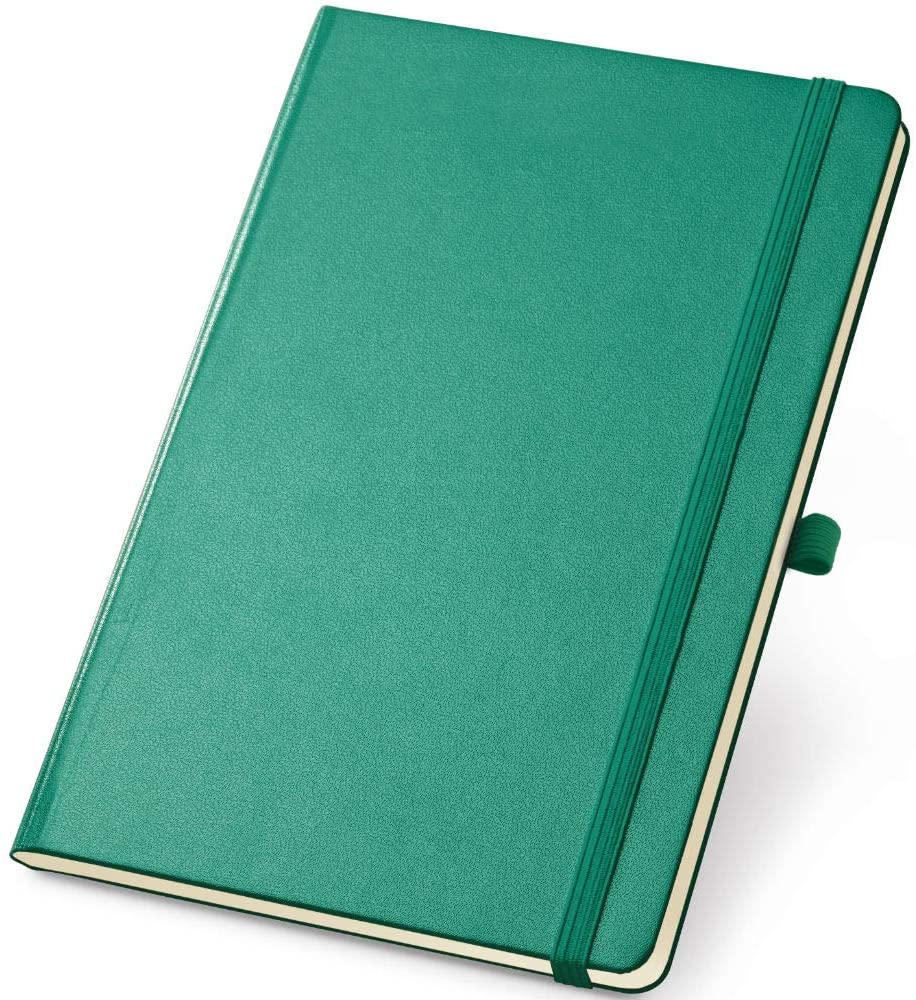
The smaller size forces us to be specific about what we write, to synthesize the subject and focus on what really matters.
A smaller blank page is also less intimidating and more inviting. You can run an experiment to see this for yourself: grab a sticky note and an A4 sheet and put them side by side. Now fill the sticky note with whatever topic comes to mind. Then, with the same topic, fill the A4 sheet. Not only will it be harder to fill, but the weight of starting is much greater, even though both start the same way. With a single word.
The lack of ruling, in turn, lets us play with the structure of our notes. We can use the shape and size of the text to give emphasis. We can draw diagrams without worrying about the number of lines, alignment, or whether things are crooked.
Unruled pages are liberating, and each page is like a canvas, ready to be painted.
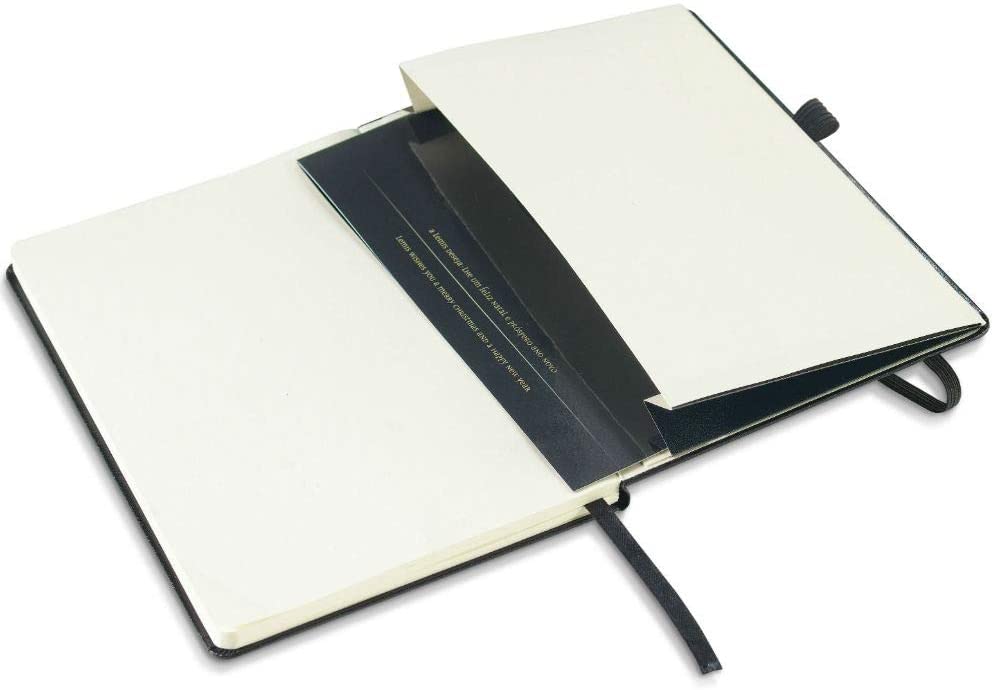
A notebook like this costs around 20 reais (Brazilian currency, a few US dollars), but it’s well worth it.
The importance of a really good pen
I’ve tried many pens over the last few years, but my favorite is still the Sakura Pigma Micron, a technical ink pen with a few important characteristics.
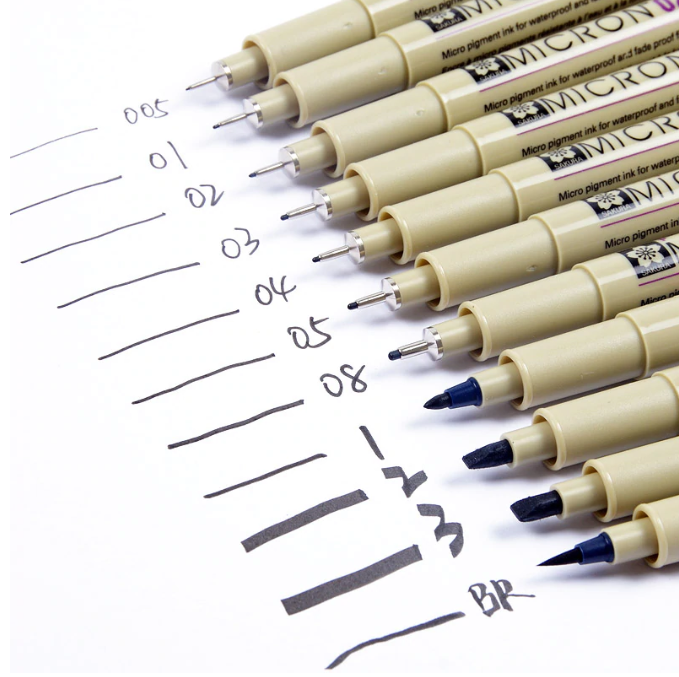
These pens have the important property of not bleeding through to the other side of the page, a common problem with cheaper pens that makes reading harder.
Another handy feature is that the ink is water-resistant. In case of an accident with liquids, the text won’t smear or fade.
As for line width, I really like pens between 0.4 and 0.5mm, because they’re very easy to read.
I chose black for the base text for two reasons. First, it contrasts more with the paper than blue does. Second, it makes it easier to use other colors to highlight important points, as we’ll see next.
Colored pens add dimensionality
At first I used only a black pen. And I used it for everything: writing, highlighting, connecting ideas, drawing, and doodling. It seemed like enough.
I underestimated the power of colors to add yet another layer of depth to the reflections laid down on paper.
When I got a set of colored felt-tip pens (by the way, one of the best gifts I’ve ever received), about a year and a half ago, I started playing with colors. It’s the Stabilo Point 88 mini line, 0.4mm.
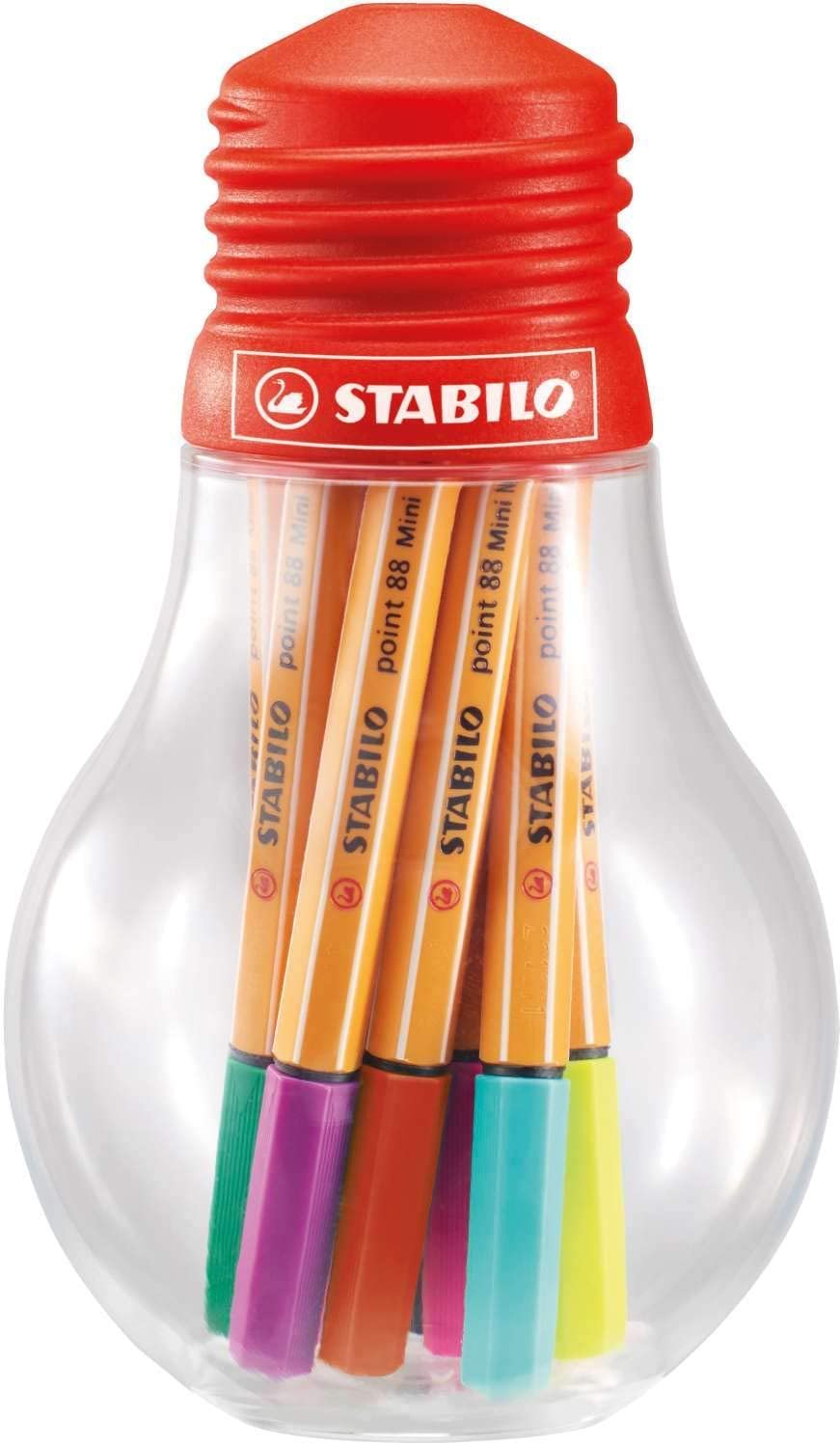
The conclusion I reached was that you don’t need more than two or three auxiliary colors. For me, they’re red and dark blue. As a last resort, I can also use purple, if the other two can’t make some content stand out enough. Generally, red and dark blue are enough.
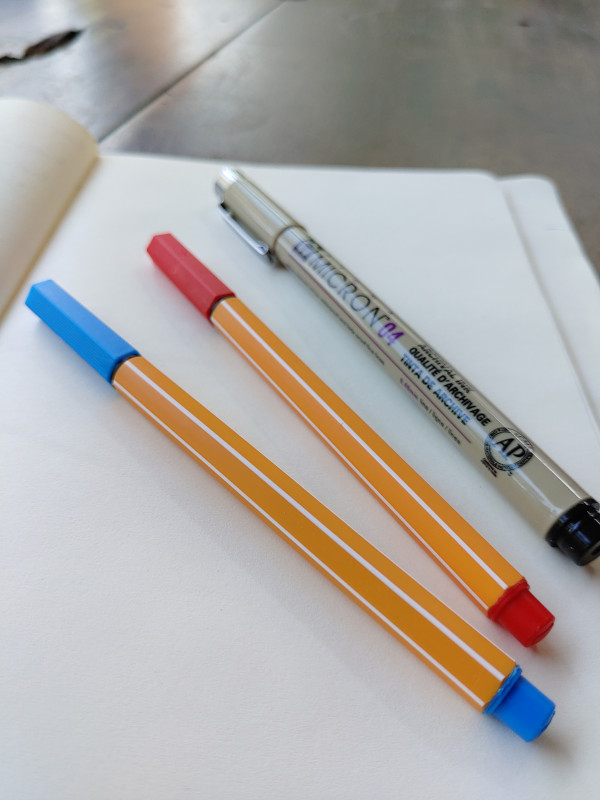
These pen sets tend to be expensive, but you can also buy the pens individually for around 6 reais each.
Language and strategies
The content that ends up in the notebook varies enormously. Some days it’ll be a summary of a subject I’m studying, other days it might be a deep reflection on an important topic, a list of tasks or goals, a journal page, a draft of a new short story. In short, whatever the situation calls for.
Over time, all these kinds of text took on certain shapes, and some ways of representing the connections between ideas and highlighting important points proved more effective than others. Below, I’ll try to distill some of these strategies.
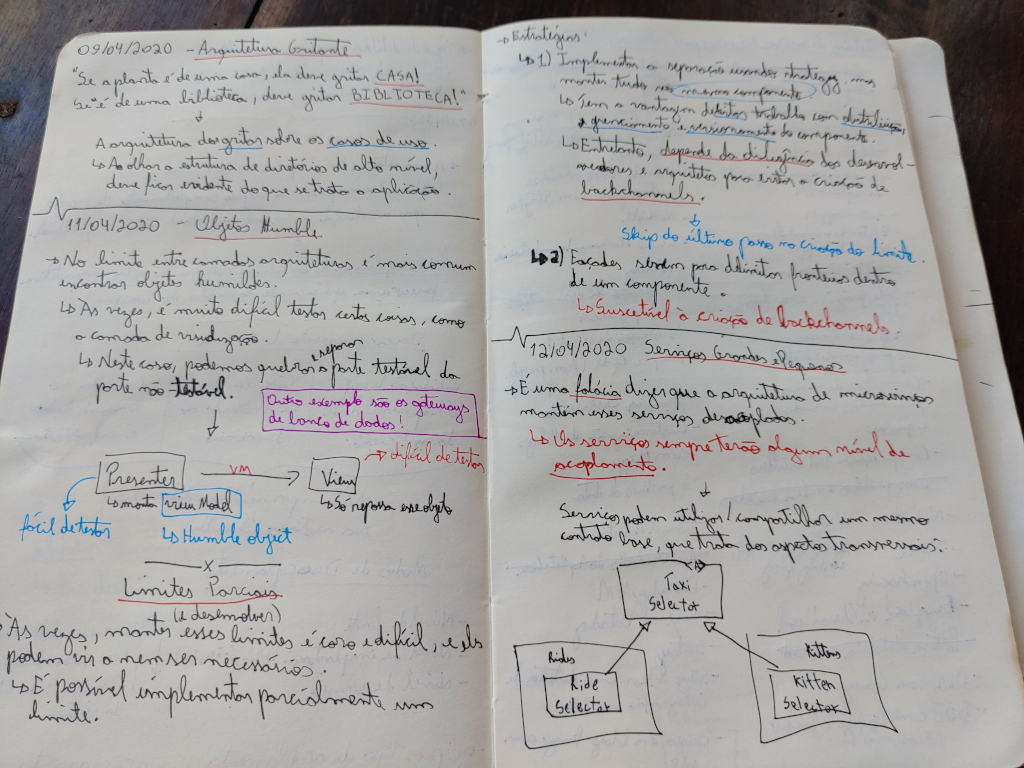
Relationships between ideas
In the image below, I tried to summarize the essence of the Screaming Architecture concept. It’s a compact excerpt that, for me, represents an entire chapter of Robert C. Martin’s book Clean Architecture.
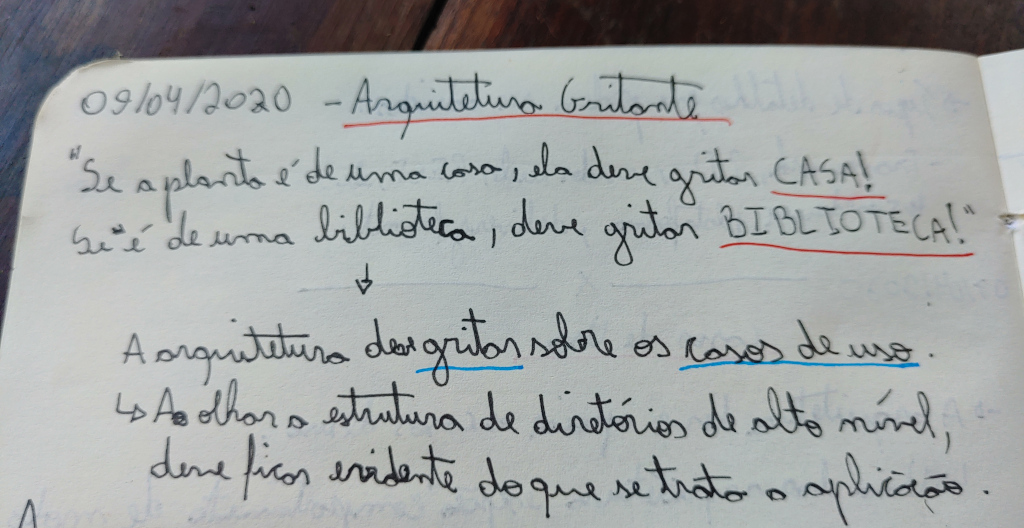
As we can see, ideas are connected by black arrows. When one idea is a direct consequence of another, I usually use a vertical arrow to show that. This notation can also represent causal relationships or chains of ideas.

When one idea is derived from another, it ends up serving as a complement. To represent this relationship, I use a ninety-degree arrow to highlight that aspect. This makes it possible to list a sequence of derived ideas. Usually these ideas only make sense when listed after the originating idea.
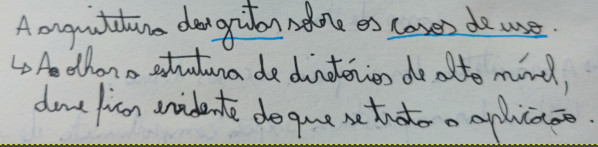
In some cases, it may make sense to represent multiple ideas that are direct consequences of a first one. In those cases, if possible, we can use one column per idea, or draw curved arrows to a point further down the page.
Colors and dimensionality
In the excerpt below, blue and red are used to highlight positive and negative characteristics of a software system’s components.
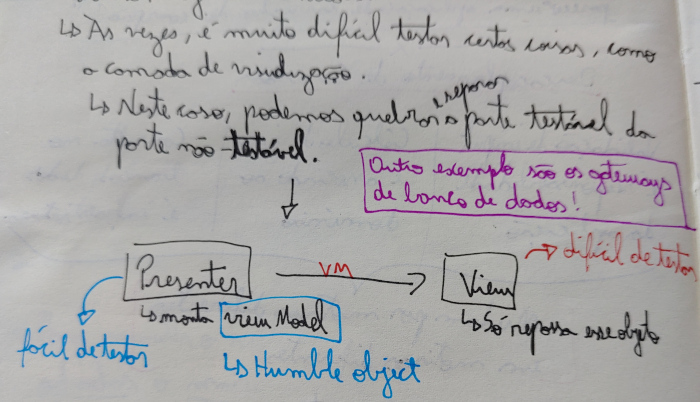
The purple box is there to highlight something related and complementary, almost like a reminder.
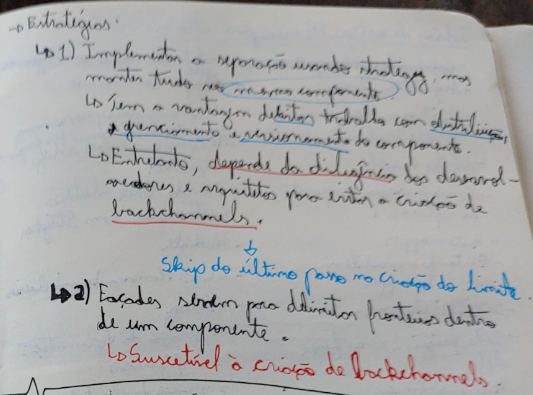
In the image below, we can see an excerpt where I used blue to highlight the positive consequences of a strategy and red for the negative ones, as well as to represent derived ideas with positive and negative aspects. This dichotomy is very common, and representing it properly brings clarity to the ideas put on paper.
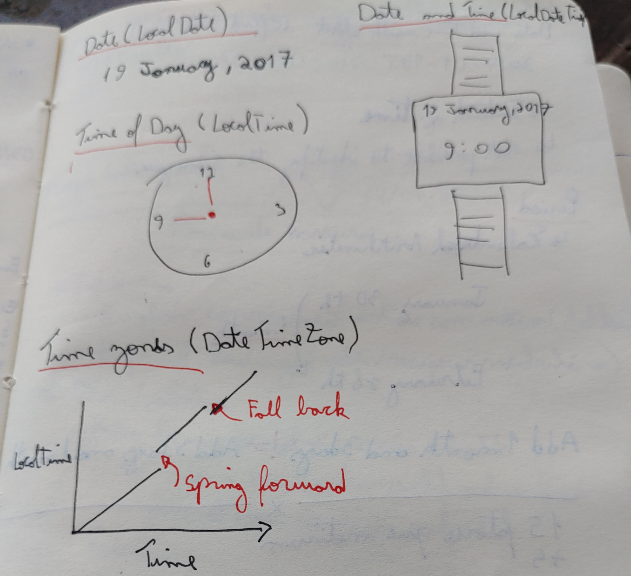
Another use of colors is highlighting topics and subtopics:
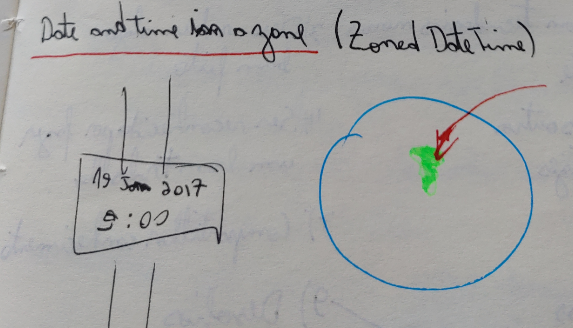
Or making small complementary illustrations:
Dates and findability
Once using the notebook becomes a habit, it can become an important reference source. That’s why it’s worth investing effort in making topics explored in the past easy to find.
I use two strategies for this:
- Titles should be highlighted in red
- Dates should be immediately visible.
Since unruled notebooks don’t come with that dedicated space for the date, we’re a bit freer to choose whatever approach works best for us.
When the first topic of the day starts on a blank page, just put the date in one of the top corners, next to the title:

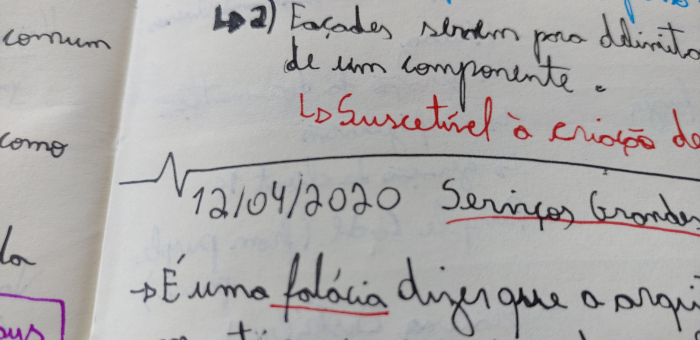
When a new date starts in the middle of a page, I came up with a marker to call attention to the date change, which makes it immediately obvious. Personally, I use this pattern that looks a bit like a heartbeat on an electrocardiogram. The heartbeat can be drawn on the left or right side of the page.
Finally, there’s the case of starting a new topic on the same date. Here, I use a simpler marker. Without it, the title would read as a continuation of the current topic.
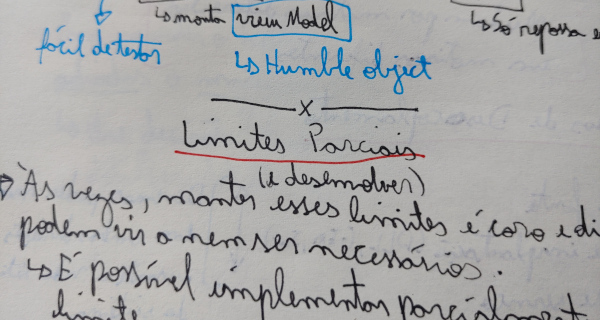
An additional strategy I’ve used in the past is building an index on the last pages of the notebook, with a title and date for each entry. These days, I think it’s more important to give titles and dates proper emphasis so they’re easy to find when flipping through the notebook.
Final words
I sincerely hope this article has shown how intentionally using a notebook as a vehicle for deep reflection can help us make better decisions, learn more and better, and understand the situations we find ourselves in. I also hope this article is useful to you, if not as a guide, then as inspiration, as an invitation to try these approaches in your own way, whatever serves you best.